
Our mission
Unlock improved learning outcomes at scale in South Africa
About the Binding Constraints Lab
The Binding Constraints Lab (BCL) is a ‘think-and-do-tank’ of education, research, implementation and advocacy specialists.
We connect and collaborate with government, researchers, philanthropy and civil society partners to focus collective energy on improving learning outcomes at scale.
While we work across the spectrum, from foundation phase through to transition into work, we have a specific focus on Foundational Literacy and Numeracy (FLN).
OUR WORK
The context
Despite significant efforts and expenditure across the public, private and social sectors:
- 81% of ten year olds cannot read for meaning;
- 65% of eleven year olds cannot add, subtract, multiply and divide one and two-digit numbers; and
- only 6.3% of matrics achieve maths passes over 60%
A fresh and innovative approach is needed to dramatically and swiftly shift learning outcomes at scale.
Our approach
We believe that systemic change can be achieved through collaboration and practical solutions.
We advocate for the adoption of evidence-informed tools and approaches. Our work involves advocacy, advisory and amplification efforts towards systemic change and includes:
- Convening, facilitation and stakeholder engagement
- Policy analysis and advisory,
- Strategic planning, budgeting, costing and modelling,
- Project management
- Connecting public, civil society, research & philanthropy partners
- Fundraising and sub-granting
Notable projects to date
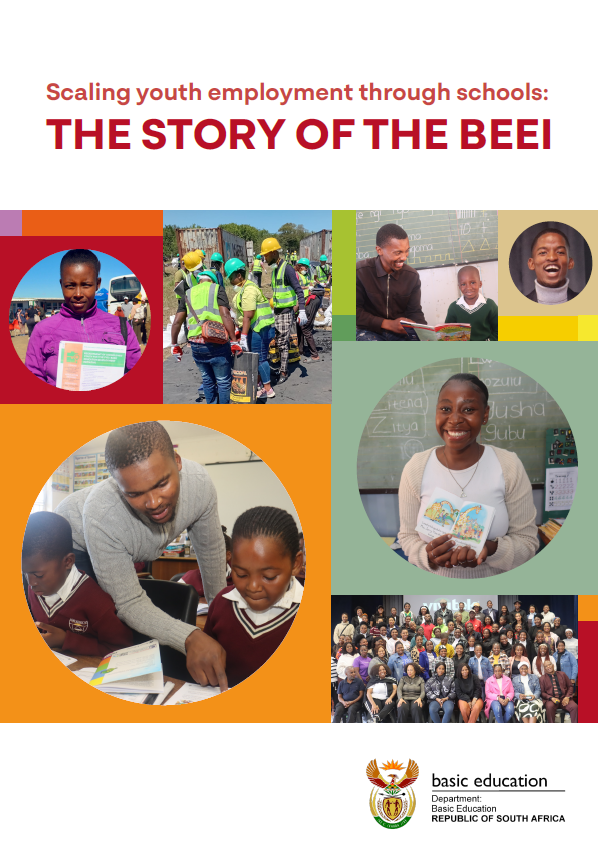
Scaling Youth Employment Through Schools: The Story of BEEI
When looking at interventions in the basic education space over the last decade, nothing comes close to the BEEI in terms of financial commitment, geographic reach, and speed of deployment. It is the largest youth employment programme in South Africa and, as far as researchers can determine, the largest education-focused public employment programme in the world.
On 24 June 2026, the Department of Basic Education (DBE), in partnership with the Binding Constraints Lab (BCL) hosted the official launch of Scaling Youth Employment Through Schools: The Story of the Basic Education Employment Initiative. The day-long event at Kleinkaap Boutique Hotel in Centurion brought together government officials, researchers, NGO partners, labour representatives, and education specialists to reflect on five phases of implementation and to set the agenda for the next.
Read: Scaling Youth Employment Through Schools: The Story of The BEEI
Lessons For Scale: Insights From The BEEI
The Basic Education Employment Initiative (BEEI) is South Africa’s largest youth employment programme, launched in 2020 to tackle youth unemployment and support schools during the Covid-19 pandemic. Managed by the Department of Basic Education, it provided nearly 1.3 million young people with work opportunities in schools while strengthening support for teachers and improving school environments across the country.
This report seeks to inform evidence-based dialogue on what it takes to achieve rapid and system-wide scale in the education ecosystem, and to unpack ways in which South Africa can strengthen its efforts to improve education and unlock youth employment.

PEPs and Foundation Phase Literacy
The Binding Constraints Lab (BCL) commissioned Katie Huston to conduct a rapid scan of Public Employment Programs (PEPs) in South Africa.
The report focuses on the PEPs design and compatibility with early literacy initiatives and the potential they present to address education as well as unemployment challenges.
EGRA-AI Project
New breakthroughs in voice-recognition AI show promising scope for automating EGRA (i.e. EGRA-AI). Using the ReadUp App developed by Western Sydney University, which uses a new open-source voice recognition model developed by Facebook (wav2vec2.0) a pilot (EGRA-AI) was developed leveraging AI to automatically assess children’s early reading abilities (letter-sounds and word-reading) in African languages.
Read: EGRA-AI poster

Support to Provincial Education Departments
Since 2023, BCL has been providing tailored support to provincial education departments to enhance foundational literacy outcomes. Our work includes assisting departments to refine and align provincial reading strategies with the DBE National Reading Literacy Plan and supporting the review and strengthening of district-level school reading improvement plans. BCL also provides technical assistance in planning and managing the procurement and delivery of learner and teacher support materials (LTSM) and facilitates targeted training for Foundation Phase educators. Furthermore, we support provinces in implementing literacy assessments to foster systemic support and readiness for scaling evidence-based interventions.
Leveraging the public employment stimulus for improved FLN outcomes
We ran cross-sectoral workshops on leveraging the public employment stimulus to improve foundation phase literacy outcomes in South Africa. To date, we have focused on how to create meaningful youth experiences by ensuring clear roles, focused training, and mentoring, enabling youth to support teachers and improve learner outcomes, in schools and at district and provincial levels.
Read: Workshop Report 1 | Workshop Report 2 | Workshop Report 3

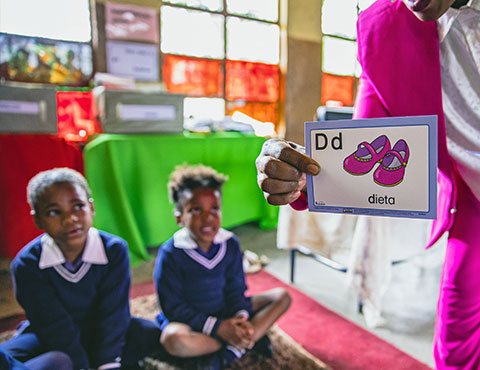
Zazi Zandi
Zazi Zandi is an early grade literacy intervention that leverages publicly funded Teaching Assistants to improve letter sound knowledge, blending and word reading skills. The intervention was co-developed with Masinyusane, The Learning Trust and Funda Wande, as a multi-phased pilot. Independent research found that learners’ letter sound knowledge improved significantly, making it clear that well trained and supported Teachers Assistants have a critical role to play in Foundation Phase interventions.
Advocacy to build demand for what works
We support a range of advocacy initiatives aiming to increase public support for improved foundation phase reading outcomes. These include the Reading Panel, the Right to Read, Rhodes Education Journalism Think Tank and the Henry Nxumalo Foundation.
Read: Reading Panel | Right to Read | Rhodes Education Journalism Think Tank | Henry Nxumalo Foundation

Improving Numeracy Outcomes, at scale
We convened stakeholders in the mathematics digital learning sector to unlock collective efforts to enhance mathematics outcomes. We are working with organisations to strengthen impact monitoring, and identify collective opportunities to enhance the potential impact of their efforts and unblock shared challenges.
Read: Latest workshop report
Our team

Sipumelele Lucwaba
Sipumelele Lucwaba brings extensive experience in funding, adjudication and implementation at a small-scale and a national level having worked for Tshikululu Social Investments, the National Education Collaboration Trust (NECT), and most recently as Head of Strategy at Funda Wande. She is currently pursuing her PhD in Law at the University of Pretoria with a research focus on the Right to Read.

Joy Olivier
Joy Olivier works across the South African education ecosystem with foundations, non-profit organisations, businesses, government departments and academic institutions in collaborative projects aiming to redress unequal access to learning and opportunities. Joy co-founded and for 15 years served as executive director of IkamvaYouth, enabling secondary school learners to access tertiary education and jobs.

Laura Poswell

Nwabisa Makaluza
Nwabisa Makaluza has experience in both fields of education and the labour-market, both from an academic perspective – having completed her PhD in Economics analysing employment in the informal sector in South Africa – as well as practically on the ground as the Programme Lead for an Early Grade Reading and Mathematics.

Tumiso Chepape
Tumiso Chepape specializes in monitoring, evaluation, and project management across non-profits, private philanthropy, and public grant-making. He previously worked at Allan & Gill Gray Philanthropy South Africa and the Government Technical Advisory Centre, supporting regional and community projects in poverty alleviation, job creation, digital training, education, and entrepreneurship across agriculture, ICT, health, finance, and business services in Southern Africa.

Lebogang Maphelela
Lebogang Maphelela brings experience in program design, implementation, and advocacy for systemic educational change. At the National Education Collaboration Trust, she led national initiatives and worked with key stakeholders, including the Department of Basic Education. She has driven impactful advocacy campaigns through strategic planning, stakeholder engagement, and research to promote large-scale change.

Nobuhle Qwabe

Maserame Mabotsa
Maserame Mabotsa is an experienced communications support administrator, bringing expertise in development and implementation of internal and external communication strategies to support organizational goals. She previously worked at the Johannesburg Development Agency (JDA) and Industrial Development Corporation (IDC) where she managed internal and external communication including content creation, social media marketing, website management, event management, media relations and internal & external stakeholder engagement.